| Arkoss | ||
| 5th Orb |
|
DigiPen |

This is the newest project I am working on. I was asked to join the team 2 semesters ahead of my class to help them
with an ambitious project they were working on. SO after a placement exam and some minor schedule shuffling I was
able to join the team in their game class. The best way to summarize the game is to say that it is a dragon flight simulation. There are going
to be two styles of gameplay, racing and combat. The racing aspect hasn't been fully flushed out yet, but it is supposed to
be something along the lines of where you fly around mountains, under canopy trees, through cloud rings, in a particular pattern
all the while shooting specific targets with your breath weapon and trying to be faster than other dragons. The other aspect of gameplay is pretty straight forward, combat.
You use your flying skills to swoop around doing battle with other dragons. There are different types of dragons, spells, breath weapons,
etc. Sounds like no problem right? Well the hard part is the simulation side. One of the requirements of the game
project for this semester is that it be a simulation of some type. This meant that the dragon we had to model will have strength, dexterity,
stamina, and have a fair amount of realistic physics. You actually have to try and fly the dragon around. This isn't like Drakan where
you can just move your mouse and the dragon just knows how to fly. You need to flap, bank, roll, adjust your pitch, watch your stamina and all
that fun stuff. This is where I come in- physics. I have been focusing only on the physics. At first
I thought it should be no problem considering my engineering background. Well, let me tell you it has been very challenging. Knowing
the physics equations is one thing. Knowing what they really mean and how they influence the entire physics model, and getting all
the equations to interact in a believable simulation is the difficult part. The other difficult part is keeping the simulation fun. If it is too
hard to fly, then the casual gamer won't enjoy it. If we remove some of the realisms, then the simulation fans won't enjoy it. It is
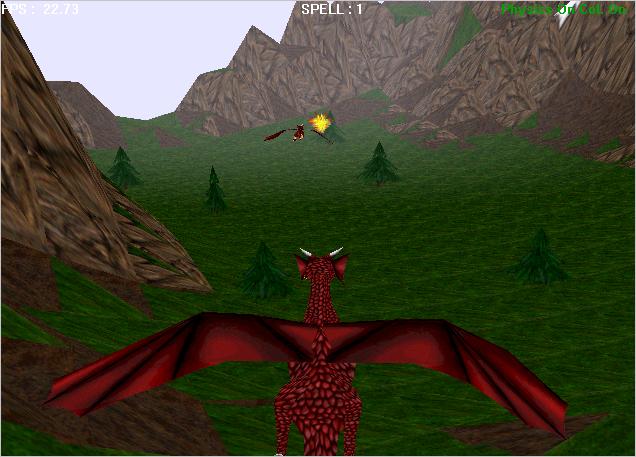
a balancing act. We shall see how it develops over the next semester. Here is a screen shot from our
first functional prototype.
Next semester there should be a web site springing up about the game with more details.

This was a fun (and very challenging) project. This project was two semesters long.
I was the designer for the first semester and the technical director for the
second semester. This time we really didn't have any constraints on the game, in the
sense of what we couldn't do. The constraints were more or less what you needed to
have in the game (full game state load save, install/uninstall, and so forth.) To read about this game
check out the web site I did for Arkoss.
The 5th Orb
This project was our first semester game. It was a text based RPG (similar to Zork- if
you remember that game), in which you could choose to be one of four different
race of characters (Orc, Dwarf, Merfolk, or Sprite). You then adventured
across the land trying to find four elemental orbs so you could "heal"
the land by creating a fifth magical orb from the four. It was pretty
cool (and big). You could cast spells depending on how you combined
the orbs, you could use melee weapons, you had inventory management, character
based skills, and over 500 different rooms to explore. We had some general
constraints on the title; it had to only be programmed in C (no C++), and could
only use ASCII graphics. I was
the Technical Director on this project, which ended up being pretty tough
(but fun). It was tough because I didn't know any C, and yet I had
to design the technical aspects of the game engine. I was thankful
that I already had a basic understanding of programming concepts and some
basic skills in other languages.
 Well, this is where you get to find out about what the school is like, and what I think of it.
Hmmm, that's a pretty big question. DigiPen is not your typical college. The programmers don't take any general education type courses English, Philosophy, History, etc. We do take core math classes, like Calculus, core programming courses...well if you want the rundown on all the classes check out the DigiPen site. Needless to say, the curriculum is very concentrated.We eat live and breathe DigiPen. The lab opens at 9AM and closes at 10PM Monday thru Friday and is open 10AM til 5PM on Saturdays. The students have successfully lobbied to get Sunday lab time during heavy workloads. :) Not every student is there from opening to closing, but many of us are. This last semester I was in lab within 30 minutes of it opening and didn't leave until the other TA's had to kick me out. Then I would head home and continue working for a few more hours. I averaged 16-17 hour days 7 days a week this last semester. Most of this was due to the large game project we decided to do (Arkoss). My first semester wasn't that bad, I averaged about 12 hour days 7 days a week. I think most students average 10-12 hr days (5-6 per week). I'm not trying to brag, just give you insight on what kind of commitment DigiPen students make. Also realize that 6 hours a day is spent in class M-F.
Of the classes I have taken so far, one of the coolest classes is of course the projects class. The project class is great for several reasons. First of all, it is what our professor calls our "Real World Class". And he's right. In the class we talk about the business side of the gaming industry: top selling games and why they were top sellers, what are the responsibilities and positions of people in gaming jobs (Producers, Product managers, Technical Directors, Designers, etc.), Technical Design Documents, Design Documents, Testing Reports, Focus groups, ESRB ratings, Development Team dynamics, and the list goes on. This class is taken every semester and continues to build on the previous semester. This is also the class where we focus on developing our game for the semester.
What else can I say about DigiPen.....the professors are cool (and let me tell you these guys know their stuff). We have games you can check out from the library and the occasional Network game tournament. First semester was a Quake II, this last semester was StarCraft. I don't know what they have planned for next semester.
Most students are aged 18-21 with about 20% of us being older. I think the oldest student is 32; most of the "older" students (myself included) are 23-26 years old. And yes, almost all of us are guys, which in my opinion is unfortunate. There are a few brave women this semester, and hopefully more will enroll in the upcoming semester to try and bring a balance to the school.
That too is a tough question. Obviously I decided to come to DigiPen because I thought it would provide me with the necessary tools to get into the game industry. When it comes to pure programming prowess (how was that for alliteration) :) I think that a DigiPen student can perform just as well as a student from a more traditional college. I think what a DigiPen grad can do is hit the ground running in a game development job. DigiPen students know what it takes to develop a game; we do it every semester (although on a somewhat smaller scale). DigiPen students are not taught hacker code tricks of programming. Our programming courses are what you would have at any university (although more accelerated). What separates our programming is that we then apply it directly to games. We also cover game specific topics in programming (path finding, image tearing, clipping, finite state machines, scrolling, ray casting, and various game API's, just to name a few). Game companies will be able to hire a DigiPen grad and get results (Step 1. place new DigiPen grad in front of a terminal. Step 2. just add Mountain Dew.) Just kidding. Really though, there will be very little "training" required if any.There is something to be said for an education which includes the "general ed" courses like English, History, etc., however. I'm not sure how gaming companies are going to look at it. I think it depends on what position the company is hiring. When it comes to being a Game Designer I think those types of courses would be beneficial. For programming I don't think they hold the same weight. That's why I think I am somewhat lucky. Since I already have a four-year degree I have had a large dose of general education courses (or I should say a more traditional education background).
DigiPen is not the only school that can teach you games programming, but it is the best. Most of the other so-called games schools (at least here in the US) had primarily an animation-based curriculum with a couple of programming courses. I wasn't able to locate any schools that actually offered accredited degrees for programming. DigiPen has been called the MIT of games programming schools and I think they're right.
Another nice thing about DigiPen is that although our main focus is games, once you graduate you can program just about anything. Hey let's face it, nobody is guaranteed a job in the gaming industry once we graduate. But that's the beauty of the curriculum at DigiPen, because we study real programming (not a bunch of quick tricks). "Standard software" companies could benefit from hiring a DigiPen grad as well.
Now you're probably reading this saying "Ahh, this guy is just blowing smoke so somebody will hire him." Well let me tell you, I'm not. This really is what I think, and I base my opinion off of personal experience and talking to other individuals in and out of the programming field. Besides, you're probably reading this so you can form your own opinion of DigiPen anyway. :)
Back to Top